
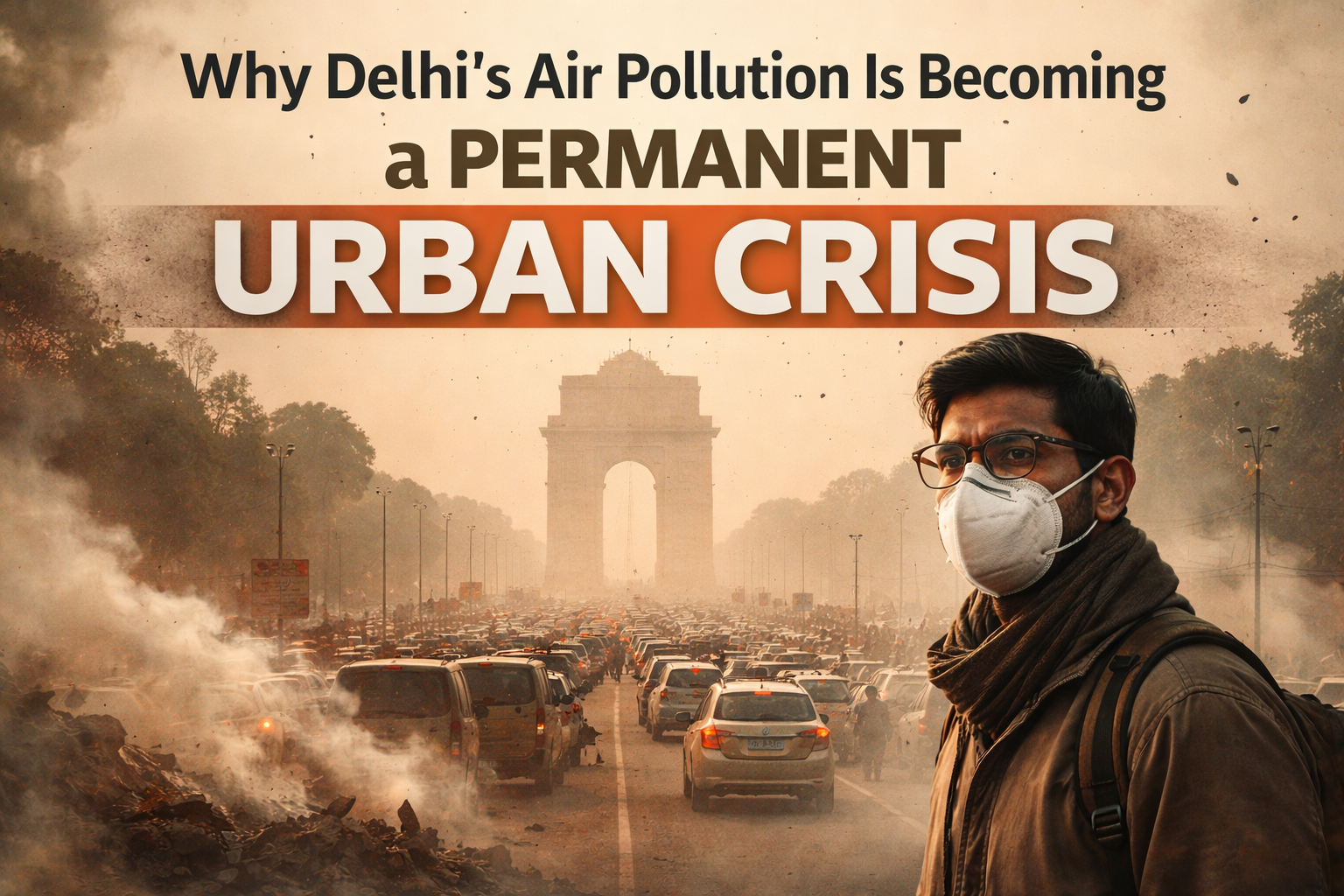

Delhi’s air pollution problem is no longer seasonal or temporary. What was once seen as a winter concern has gradually evolved into a year-round urban crisis, affecting health, productivity, and overall quality of life.
Despite recurring discussions, policy measures, and public awareness, air quality in the capital continues to remain at dangerous levels for extended periods. This raises an important question: why has air pollution in Delhi become a permanent problem rather than a solvable one?
Understanding the Scale of the Problem
Delhi consistently ranks among the cities with the poorest air quality in the world. High concentrations of particulate matter, especially PM2.5, regularly exceed safe limits. These pollutants are small enough to enter the bloodstream, leading to serious health consequences.
What makes the situation alarming is not just the intensity of pollution, but its frequency and persistence.
Multiple Sources, One Crisis
Delhi’s air pollution cannot be attributed to a single cause. It is the result of several contributing factors operating simultaneously:
- Vehicle emissions from a rapidly growing population
- Construction dust from constant urban expansion
- Industrial pollution from surrounding regions
- Seasonal agricultural burning in neighboring states
- Weather patterns that trap pollutants during colder months
The interaction of these elements makes the problem complex and difficult to address through isolated actions.
Urban Growth Without Environmental Balance
Delhi’s rapid urbanization has outpaced its environmental planning. Increased construction, higher vehicle density, and shrinking green spaces have reduced the city’s natural ability to absorb pollution.
Urban development has largely focused on infrastructure expansion, while air quality management has remained reactive rather than preventive.
Health and Lifestyle Impact
Air pollution is no longer an abstract environmental issue; it has become a daily health concern. Prolonged exposure is linked to:
- Respiratory illnesses
- Cardiovascular problems
- Reduced lung function in children
- Increased healthcare costs
- Lower productivity and quality of life
For many residents, wearing masks and using air purifiers has become a routine part of urban living.
Policy Measures: Progress With Limitations
Authorities have introduced several measures over the years, including traffic restrictions, construction bans during high pollution periods, and cleaner fuel standards. While these steps show intent, they often provide short-term relief rather than long-term solutions.
The absence of coordinated regional planning and sustained enforcement limits the effectiveness of these policies.
Why This Is a Long-Term Challenge
Delhi’s pollution crisis persists because it is rooted in structural issues:
- Regional coordination gaps
- Dependence on private vehicles
- Inadequate public transport expansion
- Weak enforcement mechanisms
- Environmental concerns taking a back seat in urban planning
Without addressing these systemic challenges, pollution levels are likely to fluctuate—but not significantly improve.
What Needs to Change
Solving Delhi’s air pollution problem requires a shift in approach:
- Long-term urban and transport planning
- Regional cooperation across states
- Stronger public transport adoption
- Investment in clean energy and green infrastructure
- Public participation and behavioral change
Air quality improvement is not just a government responsibility; it requires collective action.
Conclusion
Delhi’s air pollution is no longer a temporary crisis triggered by specific events—it is a structural urban problem shaped by growth, policy limitations, and environmental neglect.
Addressing it requires moving beyond emergency responses and focusing on sustainable, long-term solutions. Until then, clean air will remain one of the city’s most urgent yet elusive challenges.