
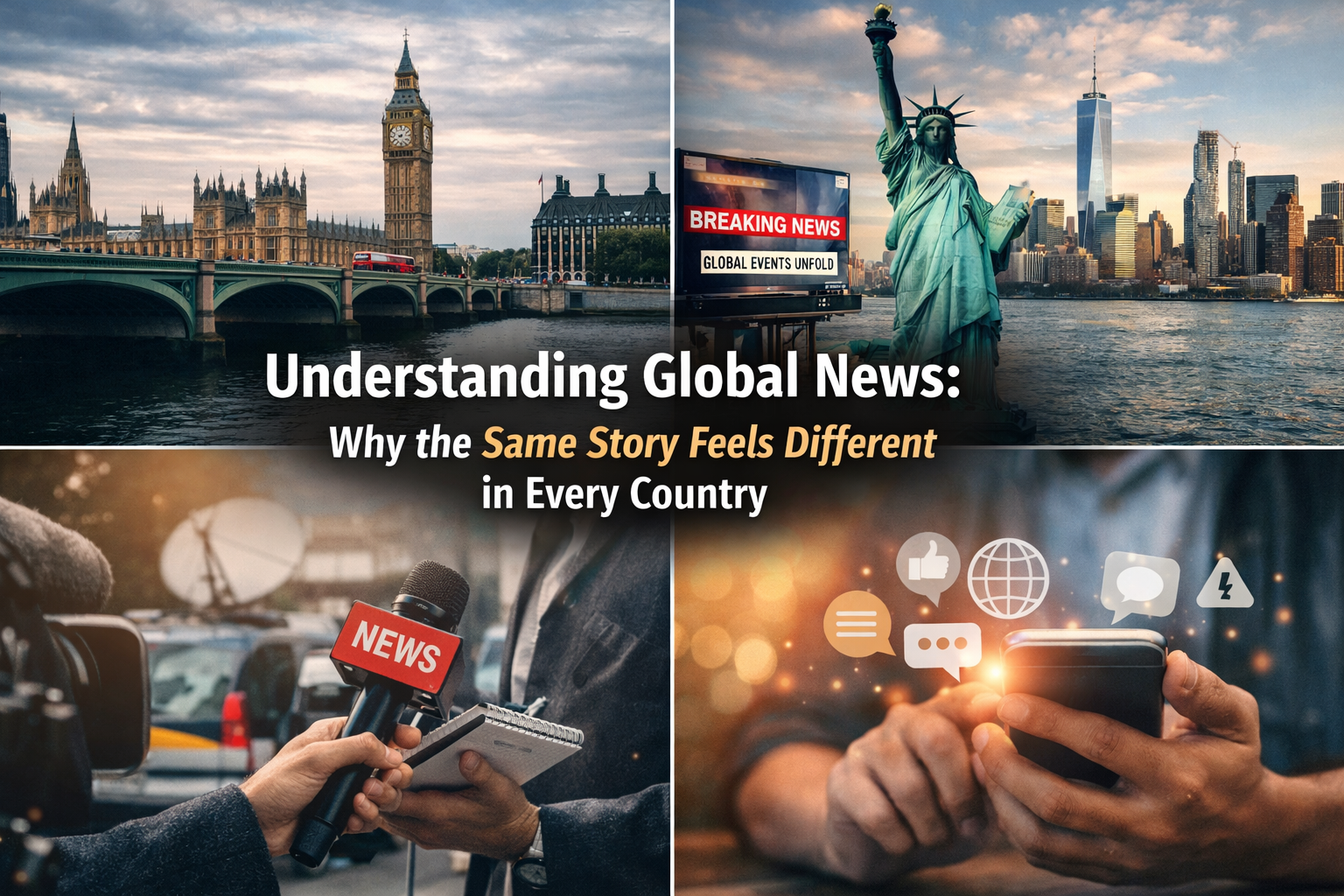

In today’s connected world, news travels faster than ever. A single event can be reported across continents within minutes. Yet, despite reading about the same incident, people in different countries often walk away with very different understandings of what actually happened.
This raises an important question: why does the same news story feel different depending on where you are in the world?
The answer lies not only in facts, but in media framing, cultural context, and audience perspective.
Media Is Not Just Information It Is Interpretation
News is often perceived as a neutral presentation of facts. In reality, media is also a form of interpretation. Editors decide:
- Which facts to highlight
- Which voices to quote
- What headline to use
- What tone to adopt
These choices shape how a story is understood. While the core event may be the same, the narrative around it changes depending on the outlet, region, and intended audience.
Cultural Context Shapes Meaning
Culture plays a significant role in how news is consumed and interpreted. Social values, history, political systems, and collective experiences influence what people consider important or alarming.
For example:
- A political protest may be framed as a fight for freedom in one country
- The same protest may be described as instability or disruption in another
Neither version is entirely false, but each reflects local perspectives and priorities.
National Interests Influence Narratives
Media organizations often operate within national boundaries and interests. This does not necessarily mean deliberate bias, but it does mean that coverage is often aligned with:
- Domestic policy concerns
- Economic relationships
- Regional alliances
- Public sentiment
As a result, international events are frequently explained through the lens of “how does this affect us?”
This naturally leads to different emphases and interpretations across borders.
The Role of Language and Framing
Even language itself can change perception. Words like crisis, conflict, reform, or security carry emotional weight. The way headlines are framed can create urgency, fear, hope, or skepticism.
A single adjective can shift how readers emotionally respond to a story before they even read the full article.
Social Media Has Amplified the Divide
Social media platforms have further intensified these differences. Algorithms prioritize content that aligns with user interests and beliefs, creating information bubbles.
As a result:
- People see more of what confirms their views
- Contradictory perspectives are filtered out
- Emotional reactions often outweigh thoughtful analysis
This makes it even harder to see global events from a balanced viewpoint.
Why Global Perspective Matters More Than Ever
Understanding that news is shaped by perspective does not mean rejecting media altogether. Instead, it encourages critical thinking.
A global perspective allows readers to:
- Compare multiple sources
- Recognize cultural and political influences
- Separate facts from framing
- Develop informed, independent opinions
In an interconnected world, awareness is not just about staying informed it is about understanding context.
Moving From Headlines to Conversations
Rather than consuming news passively, there is value in discussing it. Conversations allow for:
- Multiple viewpoints
- Deeper understanding
- Reduced polarization
- More thoughtful engagement with global issues
This is where discussion-based media becomes important not to replace news, but to make sense of it.
Conclusion
The same news story feels different in every country because it is filtered through culture, language, national interest, and media framing. Recognizing this is the first step toward becoming a more informed global citizen.
In a world full of information, understanding how stories are told is just as important as knowing what happened.